
Innovation with Intention: Leading Ethical AI in K-8 Education
As headlines frequently highlight the unknowns, common misperceptions, and understandable concerns associated with this rapidly shifting landscape, it is natural to approach this technology with a degree of caution.
At The Elisabeth Morrow School, we meet this moment by returning to the very philosophy our founder used nearly a century ago: a commitment to “the best of the old and the best of the new.” This timeless approach allows us to embrace innovation without losing sight of the foundational values that define an EMS education.
In the spring, we hosted a panel of experts on campus to continue important dialogue around AI and the future of learning. This event featured leaders in AI in education, EMS faculty, and EMS parents who are themselves leaders and executives within the AI industry, offering our community a unique opportunity to engage directly with the experts shaping this field.
Defining Our Path: What AI Is (and Isn’t) at EMS
When we discuss AI, we recognize the emotional response it can elicit. To lead with clarity, we must define exactly what this looks like in our classrooms.
What AI at EMS Isn’t
At EMS, AI is not a shortcut for answers or a way for students to bypass the essential effort of deep thinking; we are intentionally moving away from a “quick answer” mindset. It is never used for passive screen time or as a replacement for the vital human bond between teacher and student.
Instead, we remain steadfast in our commitment to active, age-appropriate, hands-on learning, ensuring that technology remains a secondary support to the mentorship and connection that define our community.
What AI at EMS Is
We view AI as a powerful tool for engagement that deepens inquiry and provides students with the real-time, personalized feedback necessary to challenge their growth. It serves as an expansion of the teacher’s toolbox, allowing our educators to spend more time on high-level mentorship by reducing administrative hurdles.
Ultimately, AI at EMS is a partnership in digital literacy — a collaborative process where students and teachers work together to navigate the imperfections of technology while building essential discernment.
AI as an Essential Literacy
As we integrate these advancements, we view AI as more than a high-tech tool. Much like reading, writing, and digital citizenship, AI is an essential literacy that involves understanding how information is created, identifying hidden biases, and knowing when to rely on a machine versus when to lean on human intuition. By teaching our students to navigate AI today, we ensure they aren’t just passive users of future technology, but fluent, critical thinkers who can use these tools to create, design, and develop transformative applications of their own.
To ensure our classrooms are ready for this integration, we built a robust foundation of safety, intentionality, and expertise. Our preparation rests on three essential pillars: securing the gold standard in ethical certification through the RAIL endorsement, providing our faculty with intensive professional development from world-class experts, and collaborating closely with our AI Parent Advisory Group to ensure our policies reflect the values of our community and the needs of the future.

The RAIL Endorsement: Our Ethical Compass
We have officially earned the Responsible AI in Learning (RAIL) Endorsement from the prestigious Middle States Association. As one of only 71 schools worldwide to earn this distinction, we met rigorous standards for safety protocols and data privacy. By adhering to the RAIL framework, we ensure that:
- Academic integrity guides our students as they learn to use these tools with a moral compass and critical thought.
- Student safety and privacy drive our decision-making through the use of vetted, secure platforms.
- Bias identification empowers our students to protect our inclusive community through proactive analysis.
Leading with Expertise: Professional Development
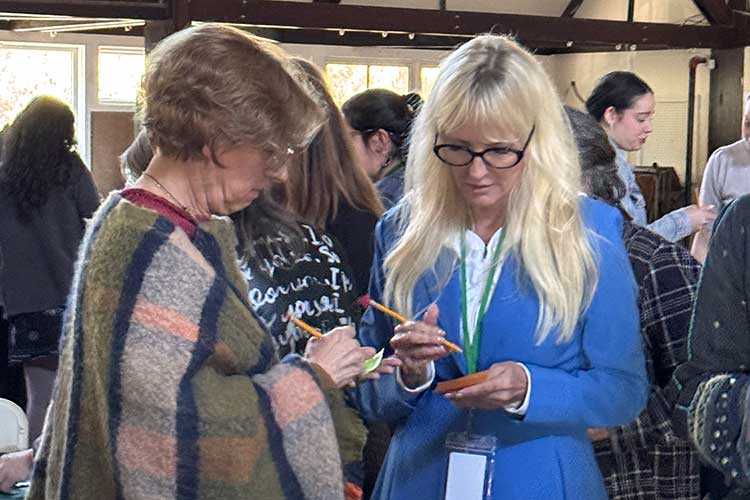
To ensure our educators lead this charge with confidence, we have prioritized intensive, ongoing professional development around artificial intelligence. Our foundation began last school year when we welcomed Holly Clark, a leading global strategist in AI in education. Her initial sessions on the “AI-Infused Classroom” explored how AI can serve as a personalized feedback tool and thought partner for both teachers and students. Building on that momentum during our mid-year PD, our staff engaged in advanced training led by Holly alongside our own Samantha Morra, a recognized leader at state and national conferences, helping us transition from initial experimentation toward expert practice.
Continuing this commitment into the current school year, we hosted Holly Clark and Adam Sparks this October for a dedicated professional development day and a parent forum moderated by Head of School Marek Beck, Ph.D. Moving beyond the noisy “ban it or embrace it” debate, our community examined what current research actually tells us about AI, screen time, and learning. Together, parents, faculty, and leadership explored how to set clear expectations, cultivate healthy digital habits, and ensure technology always serves purposeful, student-centered learning.
We maintain ongoing support through regular faculty collaboration, allowing our teachers to share real-time insights and continuously refine their approach in every classroom.

A Community Effort: The AI Parent Advisory Group
We recognize that many EMS parents are innovators and industry leaders. To benefit from this community expertise, we established an AI Parent Advisory Group. This group, which includes more than 40 parents, meets to discuss policy, ethics, and future readiness. We are fortunate to have such a dedicated group — ranging from AI executives to thoughtful advocates — helping us ensure the responsible use of this technology.
AI in the Classroom
This extensive groundwork — our rigorous certification, expert training, and community dialogue — ensures that we are ready to bring these tools into our learning spaces with confidence and care. We are thoughtfully integrating AI into our teaching methods to amplify the student experience through two distinct lenses:
Teacher-Facing Innovation
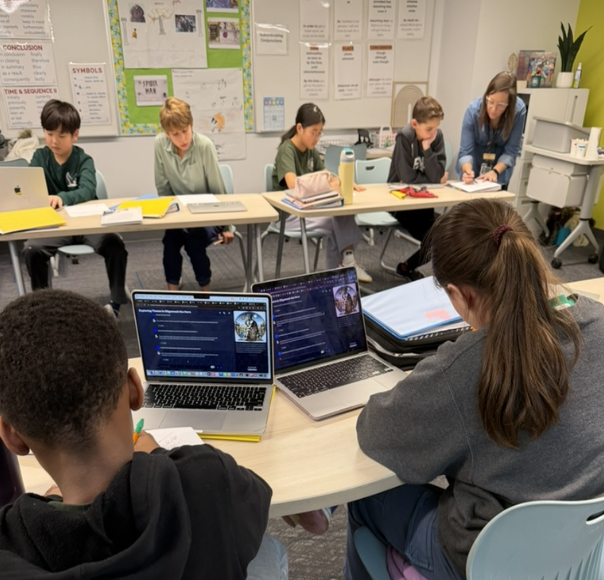
Across all divisions, our teachers use AI as a sophisticated “thought partner” to elevate their practice. In Chilton House, teachers use these tools to transform observational data into rich, narrative documentation, allowing them to better track developmental milestones and share personalized insights with families. At Little School and Morrow House, faculty use AI to differentiate complex materials instantly for diverse learning profiles, enabling them to devote more of their energy to direct mentorship and high-level facilitation.
Planning Examples:
Early Learning: In Chilton House (age 2–K), a teacher uses AI to help synthesize a week’s worth of observational notes on a child’s social-emotional growth into a clear, supportive narrative for a parent conference.
Lower School: In Little School (Grades 1–4), a second-grade teacher uses AI to take a core math concept and generate tiered word problems that maintain high cognitive demand while grounding abstract concepts in real-world scenarios. By tailoring these problems to specific student interests and practical applications — such as planning the logistics for a space mission or calculating team statistics for a soccer tournament — the teacher ensures that every student meets the same rigorous learning objective through a personally relevant lens.
Middle School: In Morrow House, a humanities teacher uses AI to perform a high-level audit of their curriculum, identifying opportunities to introduce more sophisticated primary sources and diverse perspectives, ensuring the coursework remains intellectually rigorous and challenges students to synthesize complex global themes.
Student-Facing Innovation
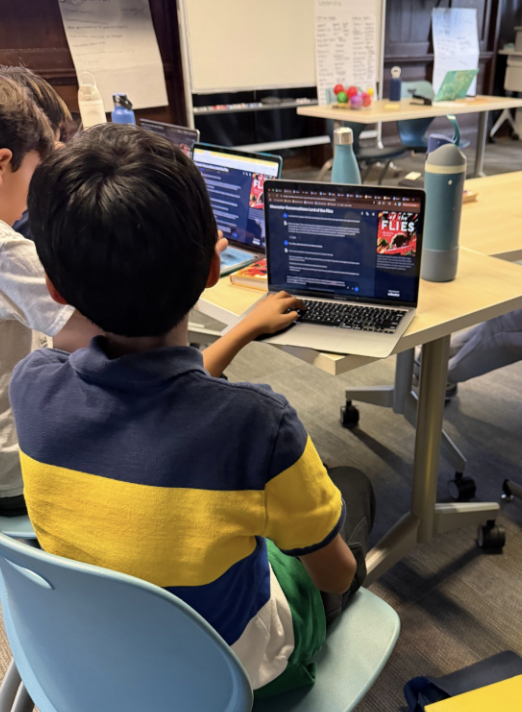
Interaction with AI progresses as students mature, following a developmental path that balances the complexity of a task with students’ growing autonomy — always under close teacher supervision. In Little School, students may use AI to help visualize complex ideas or spark creative storytelling. As they move into Morrow House, the focus shifts; students may use AI as a research partner to pressure-test arguments, explore diverse perspectives, and design original solutions, all while maintaining our rigorous academic standards and developing the critical discernment necessary for independent thought.
Project Examples:
Grade 5: A student uses AI to help brainstorm a variety of user personas for a human-centered design thinking project, using the generated profiles to identify specific human needs and then developing a physical prototype that addresses a real-world problem for one of those personas.
Grade 8: A student preparing for Ethics Bowl or Model UN uses an AI chatbot as a “Socratic partner” to find potential ethical blind spots or diplomatic counter-arguments to their position. By using the AI to simulate diverse international or philosophical perspectives, the student strengthens their own evidence-based research and develops a more nuanced, empathetic worldview.
AI Summer Institute 2026

EMS solidified its position as the regional epicenter of future-focused learning by hosting New Jersey’s inaugural AI Summer Institute from June 22–26, 2026. The high-caliber, project-based program, which welcomed more than 70 students, provided a unique opportunity for rising third through ninth graders to not just keep pace with AI, but to actively lead the technological transformation. Developed and taught by an elite team of instructors and mentors from Stanford, MIT, and Ivy League graduate programs, the Institute enabled students to explore core AI concepts, ethics, and real-world applications while developing critical thinking, creativity, and leadership skills.
