

Written by Erin Hennessy, Middle School English Teacher
How would you go about solving the problem of sleep deprivation in teens? Or improving safety in our school car line? What about making school supplies more sustainable? In Leadership Lab, a yearlong course required of all seventh- and eighth-grade students, EMS scholars are tackling complex problems such as these through engaging in human-centered design.
Design thinking is an approach to solving real-world problems that incorporates many of the skills students already use on a daily basis. Like the writing process, the engineering process, or the creative process, design thinking involves an iterative process where participants move through a series of cyclical stages involving drafting, testing, and revising. Human-centered design focuses on solving real-world problems using a lens that prioritizes human experience. When students engage in human-centered design, they learn how to reframe problems and generate solutions from a variety of perspectives, and this transforms their ability to develop more innovative, effective solutions. It also fosters empathy, which is at the heart of human-centered design.
Building a Broader Transdisciplinary Approach
I came to design thinking about a decade ago while serving as English department chair and co-director of a leadership program for girls. My school offered me the opportunity to gain extensive training from educators who worked with the Stanford d.School. Immediately I began to see the impact that this kind of learning can have on students of all ages. They become better observers, more creative problem solvers, more open-minded, and more empathetic. They learned to consider the ethical impacts of their solutions and grew into more confident communicators. As I work with students in our seventh-grade Leadership Lab class now, I see the same transformation happening for them.
Three years ago, when I joined EMS, I started co-teaching studio classes to learn NuVu’s approach to teaching design. I appreciated the expertise in engineering and applied sciences that NuVu brought to the process, and I liked that our partnership with NuVuX trained many of our teachers to incorporate design thinking into their courses. When our two-year partnership with the NuVuX network was wrapping up, I jumped at the chance to help shape the next iteration of the program. I knew that incorporating human-centered design and ethics into the curriculum would strengthen the work we were doing and give our students an advantage when applying to competitive high schools.
EMS has now adopted the methods and mindsets used at the Hasso Plattner Institute of Design at Stanford University, IDEO, and even Harvard Business School, three organizations at the forefront of design thinking education for students at all levels and across many disciplines. This expands the resources available to us and supports a broader transdisciplinary approach. When students step into Leadership Lab, they may draw on their research skills from humanities class, calculation skills from math class, observation skills from science class, communication skills from English class, and coding skills from computer science class, all while working on developing their 21st-century skills: collaboration, creativity, critical thinking, and communication.
What this looks like in the classroom is dynamic, innovative, and occasionally messy. Learning happens through experience, and our motto is “We start before we are ready.” Our Leadership Lab curriculum is grounded in essential questions that provide focus: How do I identify, explore, investigate, and understand problems in the world around me? What questions might I ask to help me become a better problem solver? How might consideration of the ethical issues change my approach or the outcome? During the first class, students are introduced to the skills they will learn and why they’ll need them: 85% of the jobs that will exist in 2030 haven’t been invented yet. It’s a lot for them to absorb, but the conversation is always a thoughtful one. By the second class, they engage in a design sprint, a quick scaled-down exercise in design thinking that teaches them the steps in the design process. This starts with framing a problem as a thoughtful design-thinking question, typically called “how might we…” questions. This year, we asked, how might we improve someone’s experience of riding a school bus? Grappling with an easily relatable question allows students to focus on learning the design process they will use for the group’s future projects.
What this looks like in the classroom is dynamic, innovative, and occasionally messy. Learning happens through experience, and our motto is: We start before we are ready.
Design Process Stages

Each stage of the human-centered design process incorporates activities that support students in developing the skills, mindsets, and methods to center the human experience and impact while solving meaningful problems. In the first stage, “Notice and Empathize,” one of the early activities students complete is an observational walk through the campus. Before the walk, the class discusses entrepreneurs and changemakers and how they view problems as opportunities, helping students shift from a deficit mindset to an opportunity mindset. Next, students learn about stakeholders and end users and how to conduct empathy interviews to elicit stories and uncover emotions as they gather data in response to their observations.
When asked about how these interviews informed their projects, seventh-grade students talked about discovering surprising and useful insights. Scarlett S. shares, “When we first began our project, we learned that Mr. Love was upset about cars speeding away from the car line,” so the group decided to focus on pedestrian safety. Then, after conducting more interviews, the group refined their original goal to fit the circumstances of our school’s needs and focus more narrowly on a specific problem.
As students move into the second stage, “Define the Problem,” they share their early findings in their group and categorize the problems they have identified; they may use the United Nations Sustainable Development Goals or categories of their own design. One of the most challenging steps in group collaboration is learning to find consensus: Each team must identify one problem to explore together. After researching background information on their selected problem, including existing solutions, they write a problem statement. They can do this in the form of User→ Goal→ Context→ Benefit or as a “how might we” question. For example, “Ben needs a way to find space for his soccer equipment while riding on a school bus,” or “Lia needs a way to cancel out all of the noise while riding on a school bus so that they can relax and read a book,” or “How might we reduce the amount of trash Max creates in a day?” By defining a narrow and specific problem and focusing on a particular user’s needs, students have a target to return to as they iterate and prototype their design solution.
During the third stage, “Ideate,” students use brainstorming strategies, such as the SCAMPER method (substitute, combine, adapt, modify, put to another use, eliminate, rearrange) or the “worst ideas possible challenge” (purposely come up with the bad solutions to a problem) to help them generate many possible solutions without rushing to judgment. Their ideas are recorded and sketched through words and images to better help them imagine and explore possibilities for their own solutions. If existing precedents might inform a proposed solution, they are researched at this stage.
As students narrow their ideas and begin to build prototypes, the human-centered design approach is building “to think” as well as “to inform.” Through rapid prototyping, students create a low-fidelity solution that allows them to “Test and Revise” by sharing it with their end users and stakeholders to gather feedback from the community before a design is finalized. Students may revise their prototypes and begin the feedback cycle again. When time allows, students explore the ethical implications of their design (this is one aspect of the course that I’d like to develop further in the future!). Once students approach solutions, the focus shifts from design to storytelling, and each group must create a pitch to “Communicate” their problem, process, and solution.
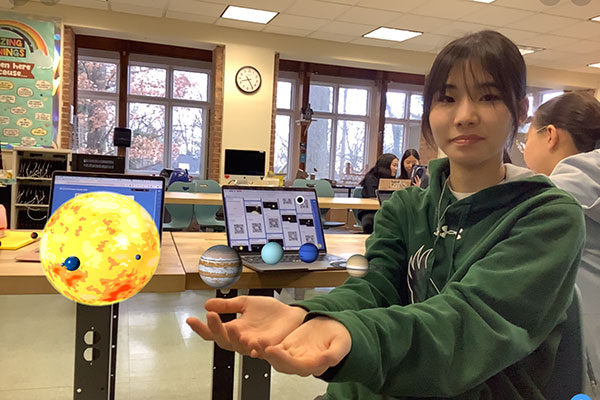
While human-centered design is at the forefront of Leadership Lab, students utilize the same skills in many of their classes, for example, when they design a university brochure or website grounded in the values and innovations of the Song Dynasty for their humanities project, when they create a virtual/augmented reality connected to literature or history in computer science class, or even when they plan a new school event through student government. Human-centered design focuses on the process and mindset as well as the outcome, which empowers students to identify meaningful projects and approach them flexibly in a changing landscape. It helps them to observe and interact with the world with a greater appreciation for humanity. It forces them to seek insights to discover new possibilities and avoid rushing to solutions. Ultimately, they develop a better understanding of human motivations, behaviors, and challenges and develop tailored solutions that are more effective and sustainable. Most importantly, they come to see that ordinary citizens have the power to change the world. To me, there is no lesson more important than that.
There's No Better Time to Support Your Child's Education
Every time you donate to one of Elisabeth Morrow's dedicated funds, you help enrich the daily experiences of our community on campus. STEAM spaces are enhanced, library catalogs are expanded, scholarships are funded, and teachers are hired. Every day, you can see the impact your generous donations have on campus.
